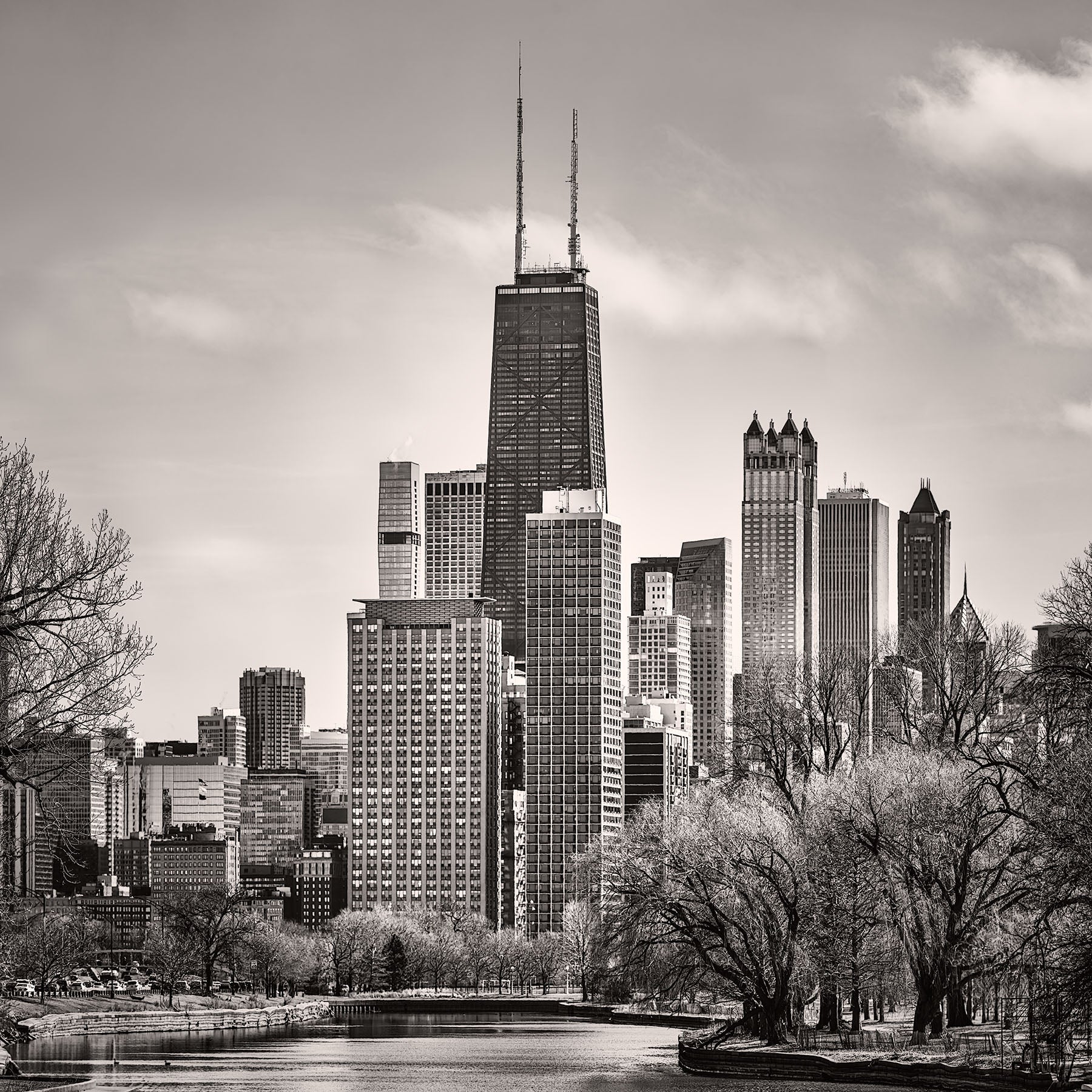
Gold Coast Skyline from Fullerton Avenue Bridge
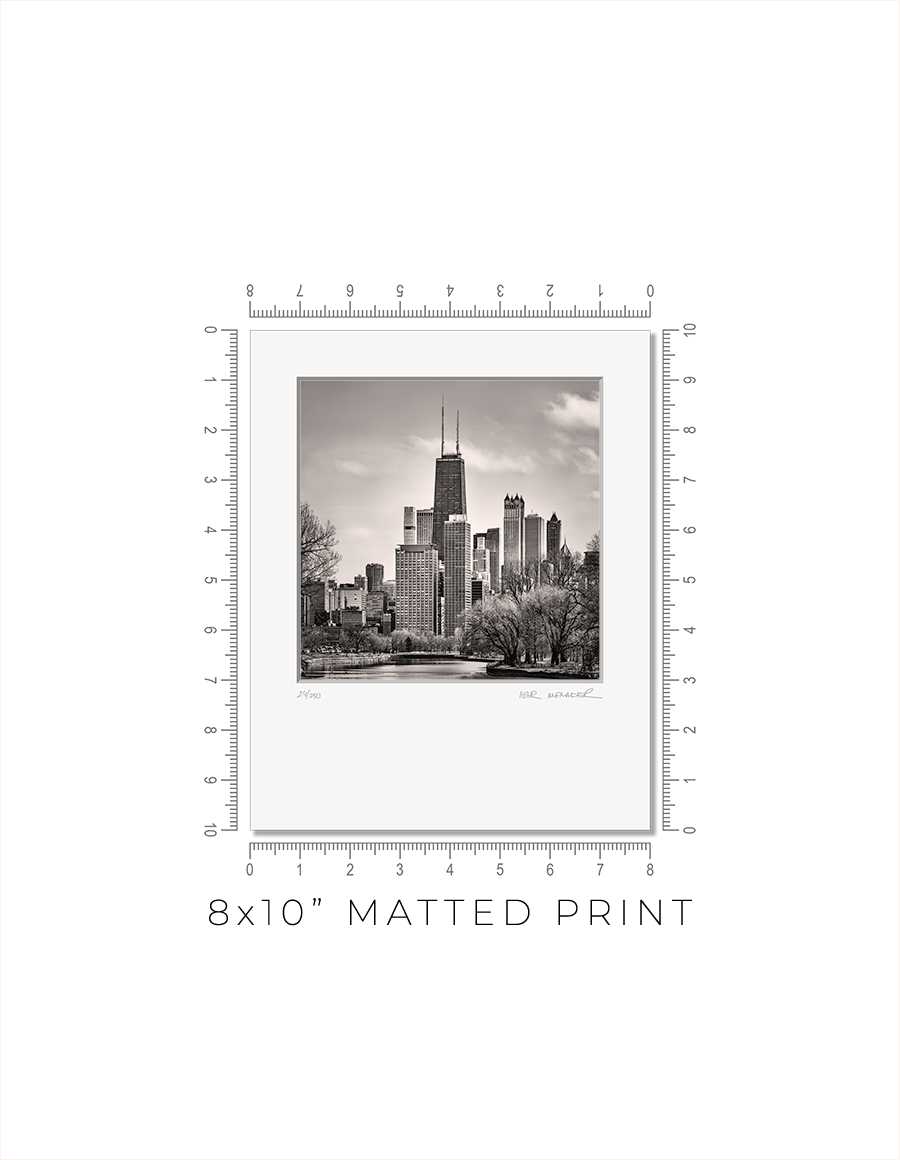
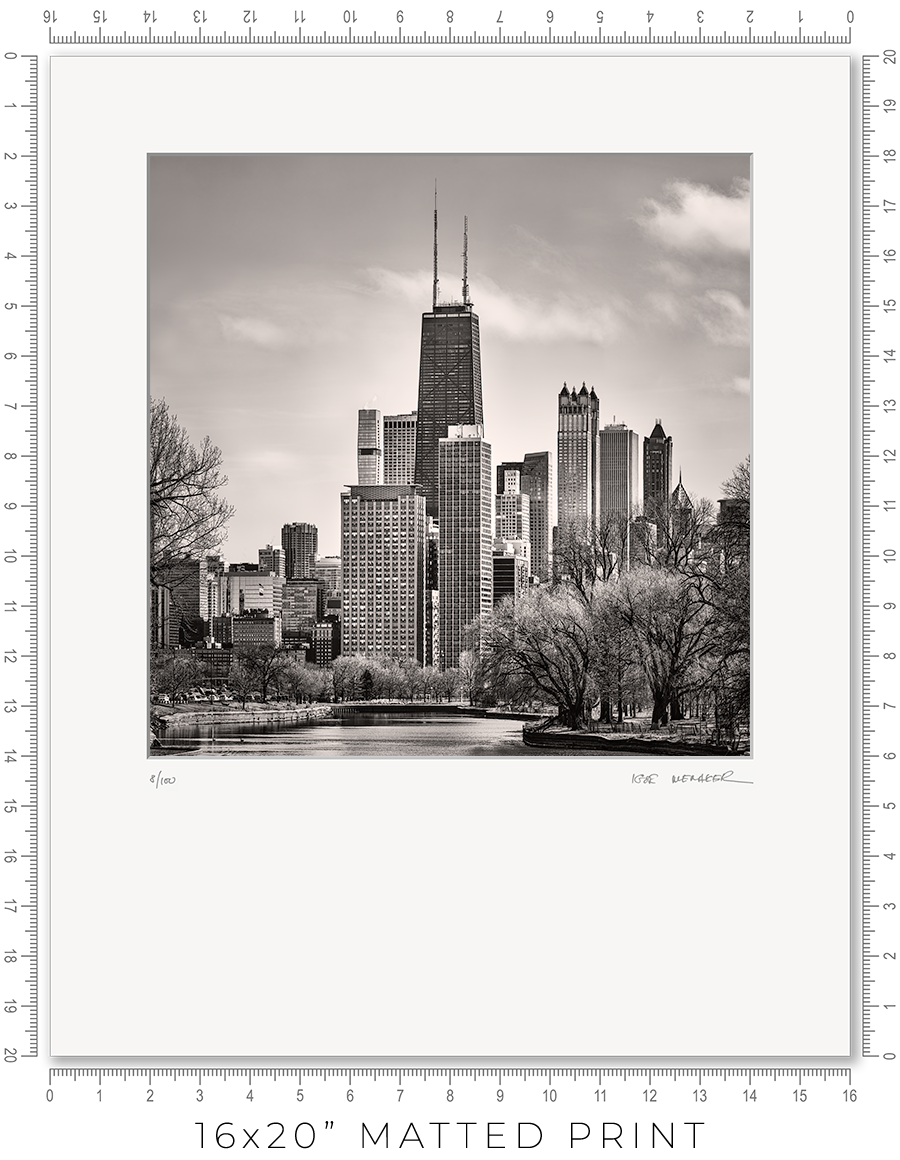
Matted prints are a great option if you want to choose your own frame. They come in two sizes: 8x10" and 16x20". These are standard frame sizes. You may easily find these frames at any retail shop.
One thing you need to know about frames. Those cheap, thin frames with swivel locks and kickstands will not work. They are designed for simple photo prints or diplomas. The matted print will be too thick for these frames. Find a decent frame that is at least 1" deep.
I make every print myself in my studio. No photo lab. No outsourcing. Every print is handmade.
I print on metallic photo paper. It is the perfect paper for black-and-white architectural photography. It adds a distinctive pearlescent, three-dimensional sheen to the prints.
For mats, I use 4-ply Crescent Arctic White matboard. It is off-white, traditional, and restrained. Not bright white, which is too bright and overwhelms the image. This matboard is the archival standard for conservation framing.
I mount prints on 3/16" Bainbridge foamcore. It is acid-free, clay-coated, rigid, and lightweight. It is ideal for archival print mounting.
The print is permanently sealed between the mat and the mounting board. It is intentional. A hinge mount leaves the print too loose. Also, it causes the print to bulge in the middle. A sealed mount keeps the print flat and tight. If you need a hinge mount or a matboard backing instead of foamcore, let me know.
Every print is signed and numbered (limited edition) on the mat in pencil. On the back, you will find a Certificate of Authenticity with all the details about the print and my contact information.
The actual photo print size for an 8x10” matted print is 6x6” with a 1” mat border, and for a 16x20” print, it is 12x12” with a 2” mat border. Since the photo prints are square and the matted prints are rectangular, the bottom mat border for 8x10” prints is 2” and for 16x20” prints it is 6”.
A framed print is a finished artwork. It is not just the image, it is a physical object that looks intentional, lasts decades, and feels complete.
The frame color, finish, and moulding profile. Print mounting, matting, and glazing. These are all deliberate decisions that elevate the image to the level of an artwork, which you can hold in your hands, put on the wall, and live with every day.
I am a professional framer, and I enjoy making frames for my prints. I put a lot of thought into what frame to use for my prints. And how to mat, glaze, and mount them. And after decades of frame-making, I acquired the skills to make my prints perfect, exactly the way I want them. I am proud of what I do.
I make every print myself in my studio. No photo lab. No outsourcing. Every print is personally crafted by me.
I start with printing the image on one of my large-format printers. I use glossy metallic photo paper almost exclusively. It is the perfect paper for black-and-white architectural photography. It adds a distinctive pearlescent, three-dimensional sheen to the print. In a bright spotlight, it looks like a hologram.
For glazing, I seal the print with archival 5-mil PET film, featuring a unique, high-gloss “mirror-like” finish. There is only one manufacturer of this glazing, the price has doubled in recent years, and it is issued in small batches that sell out instantly. But the result is worth the trouble. It gives the print that elusive look of a silver gelatin print from a traditional darkroom, which was treated with a vintage photo heat glossier.
I have been a photographer all my life, and I still have my traditional darkroom. I can produce small silver gelatin prints, but large 44x44” prints are obviously out of reach with this old technology. I am happy that I can replicate that look and feel for the prints on any scale with the new technology I developed.
But this is my choice. If you prefer to use museum anti-reflective glass sheets, please let me know. I can do that, but the print prices may double (since glass is expensive), and delivery will be limited to Chicagoland only (because it is glass and it breaks in shipping).
I permanently mount my prints to white aluminum Dibond sheets using archival pressure-sensitive high-tack acrylic adhesive. It is not a simple process. I use a heavy 750-pound, 60” wide large-format laminator to complete this task. And it is the most dangerous and nerve-racking stage in the whole printmaking process. A tiny misalignment or a speck of debris on the surface can ruin the almost-finished print.
Finally, the print is ready for framing. Frame-making is where a woodworker meets an artist. It is a totally different set of skills, materials, instruments, and studio space.
Over the years, I developed relationships with several suppliers, and I get my frame moulding delivered by truck in large, long boxes. I believe my studio stocks more frame moulding than your average frame shop down the street.
I cut the moulding at 45 degrees using my mitre saw mounted on a custom 10-foot-long, heavy-duty feed bench I built long ago. I then join the cut sticks with a pneumatic v-nailer to make a square frame. Now the finishing touches: I sand and paint the frame corners to make them even and smooth.
Now it is time to put the print and the frame together. I secure the print inside the frame with flexible points and install the hanging wire (or D-rings for the large prints). I sign the print, attach the Certificate of Authenticity, and the print is ready.
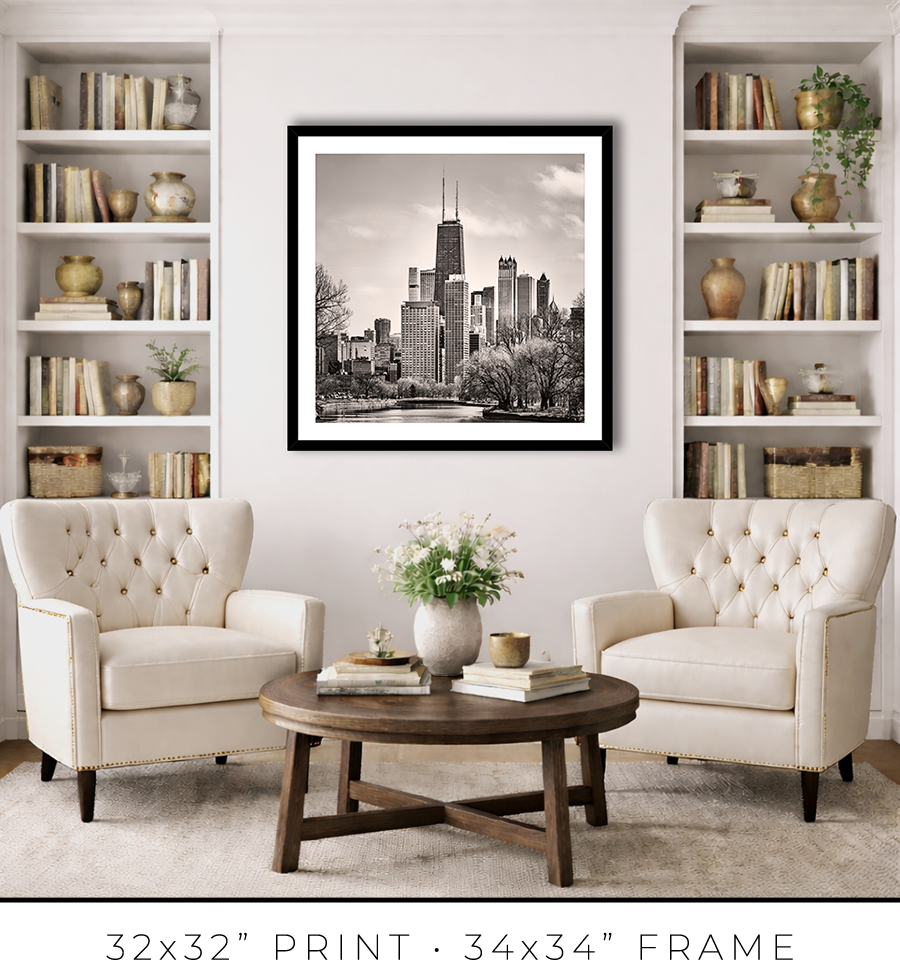
Now, let’s talk about the frames I use for my prints. In my opinion, black-and-white photography does not require elaborate framing. A simple but sophisticated matte black frame is all that is needed. It is like the famous Audrey Hepburn’s "little black dress" designed by Hubert de Givenchy for the movie “Breakfast at Tiffany's”. It became iconic and has been described as "perhaps the most famous little black dress of all time." Accordingly, a “little black frame” is all that is needed for my prints.
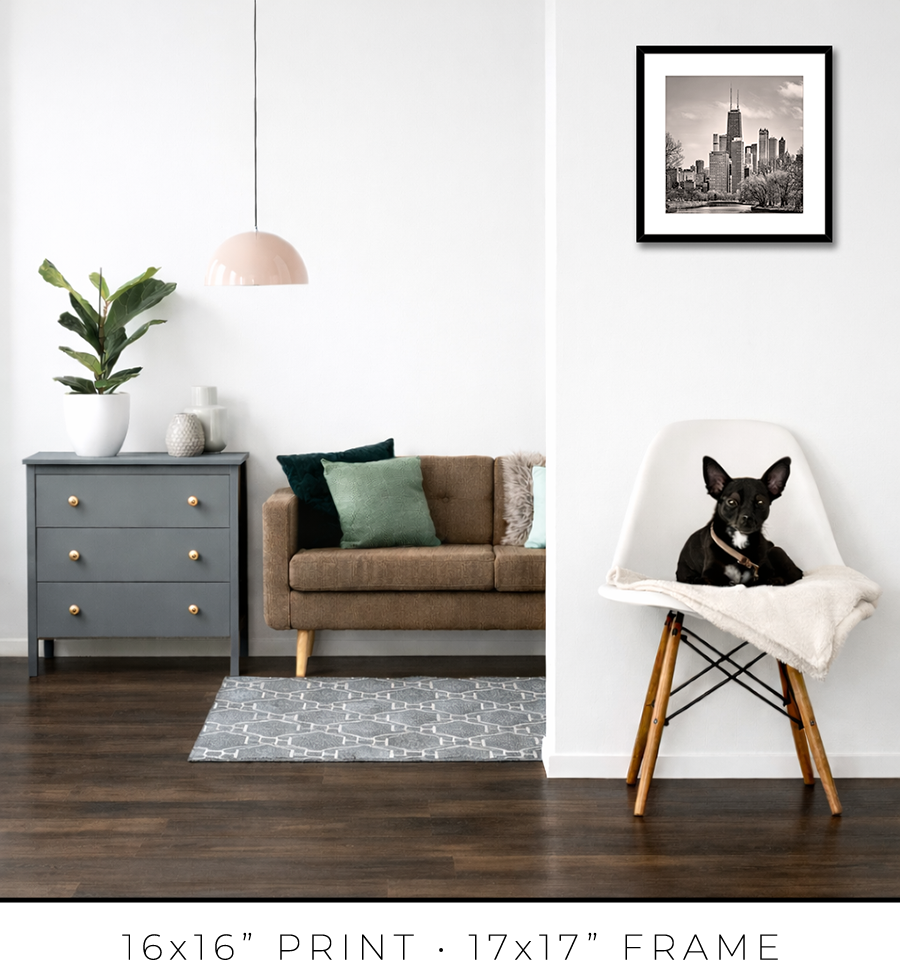
For 16x16” prints, I use a simple 3/4” matte black frame, but it is 1 1/8” tall, which adds a touch of sophistication. It looks proportional to the relatively small size of the 16x16” print.


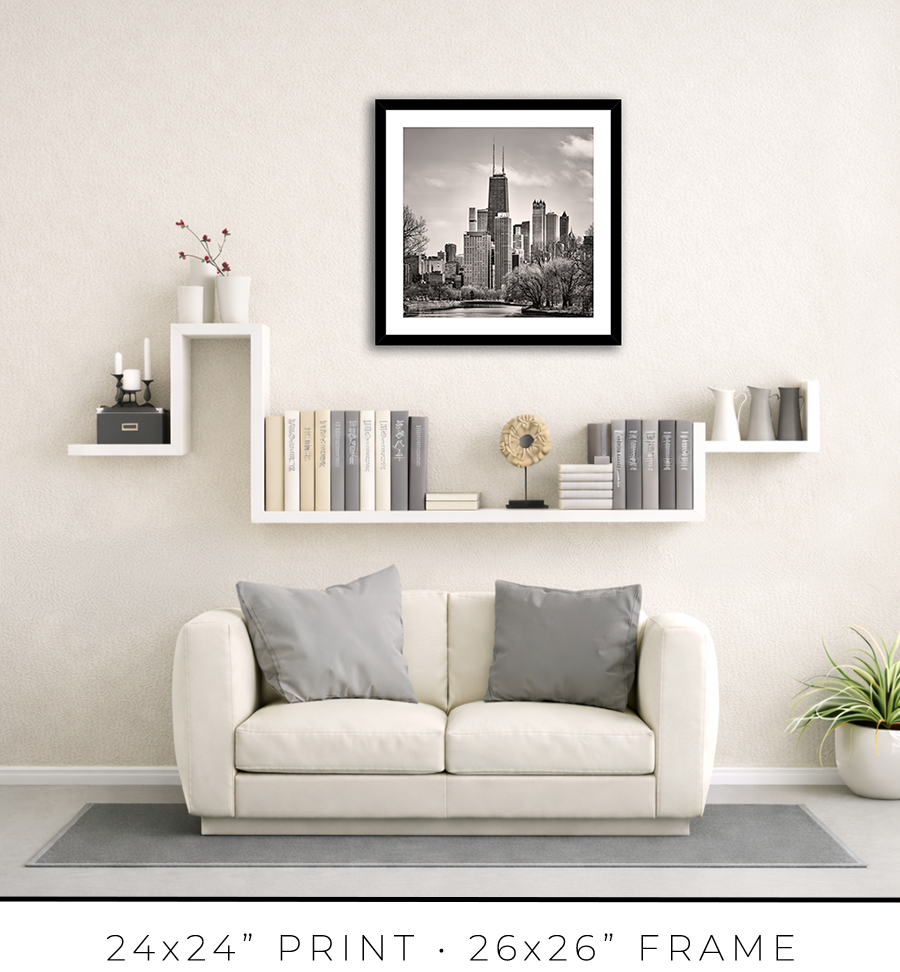
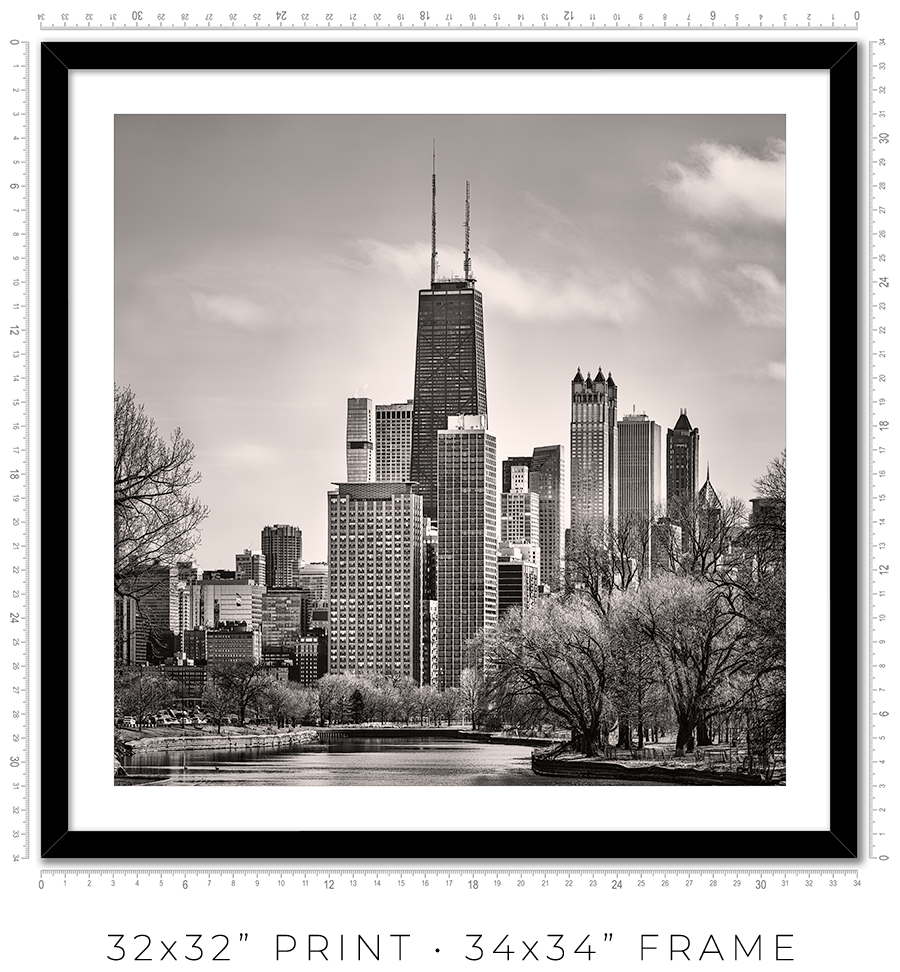
For 24x24” and 32x32” prints, I use the same style but a different profile frame. It is a wider 1 1/4" frame, which works for larger print sizes. And it is not as tall, only 7/8", which keeps the prints more grounded on the wall and less overpowering.


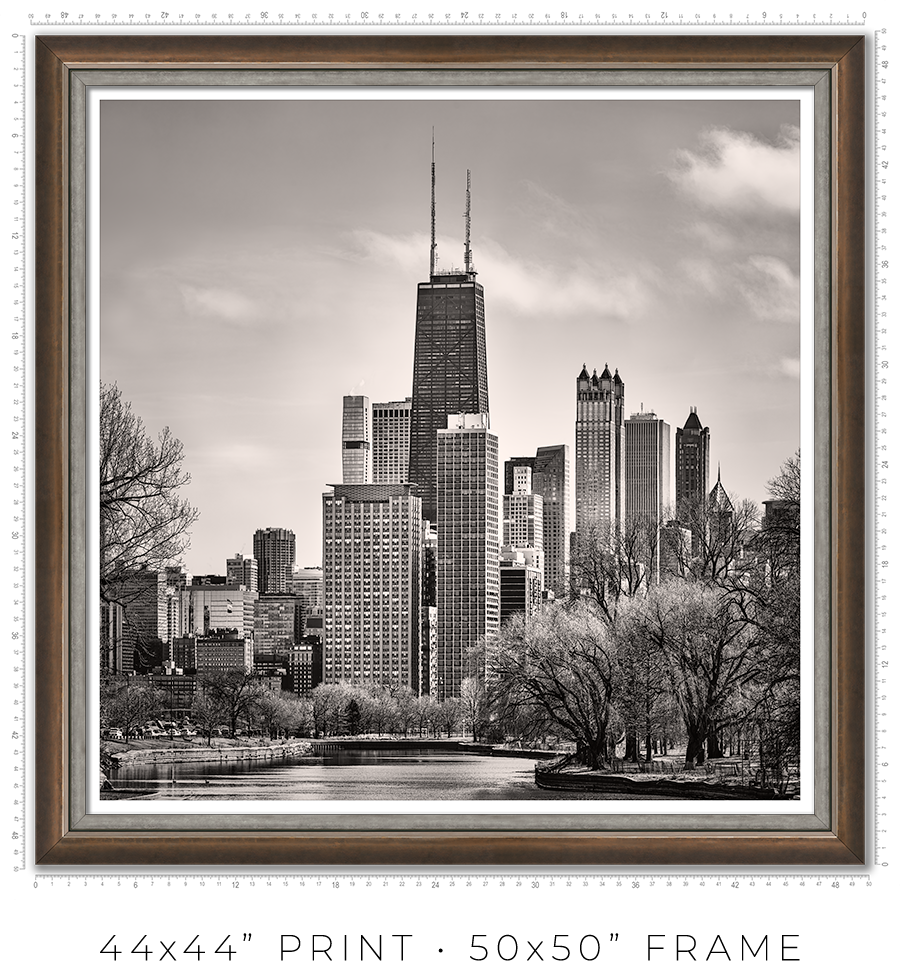
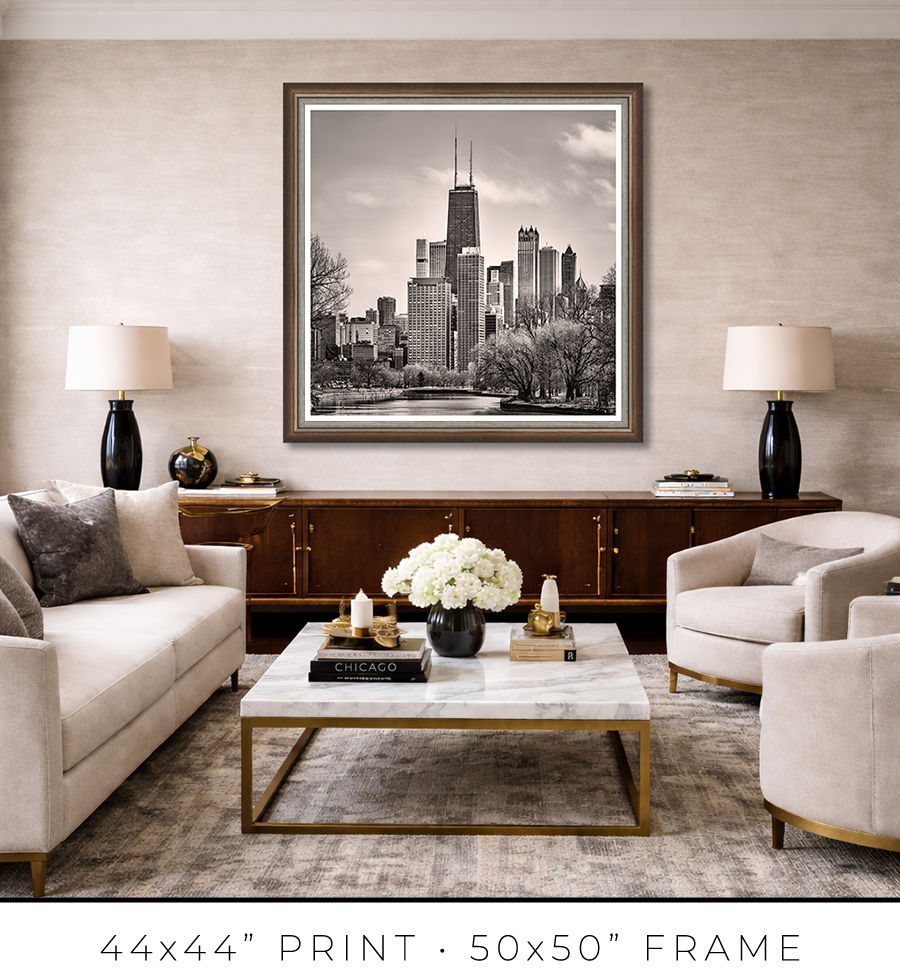
For large 44x44” prints, the frame design requires a totally different approach. Compared to smaller prints, the large print is a statement, it is a centerpiece of the room. It is a celebration, and the "little black dress" concept doesn’t work here. It needs a bit of exuberance. At the same time, it has to be constrained and confident. Like a Rolls-Royce brand identity.
To meet this challenge, I came up with a design of two different frames stacked together to form a unified frame for large prints.
The main frame is one of the most expensive frames I used, a custom frame made in Italy. It is 2” tall and 2” wide. It is a block, but it has a bevel on the inside. The beauty is in color, or to be precise, in color gradation. It is dark charcoal on the outer sides, which gradually transforms into a patina of silver leaf on the inner bevel through dark copper leaf on the front side. The beauty is that the gradation is not even, it looks painted by hand. It looks authentic, rustic, and antique.

The secondary frame is 1 1/8" wide, and it has a similar rustic, scratched, antique look, but it is pewter, which is almost the same color tonality as a photographic print it frames. It is more restrained than the primary frame and works well as a separator. Also, it has this chiseled, rough edge, another detail that adds authenticity to the whole frame.


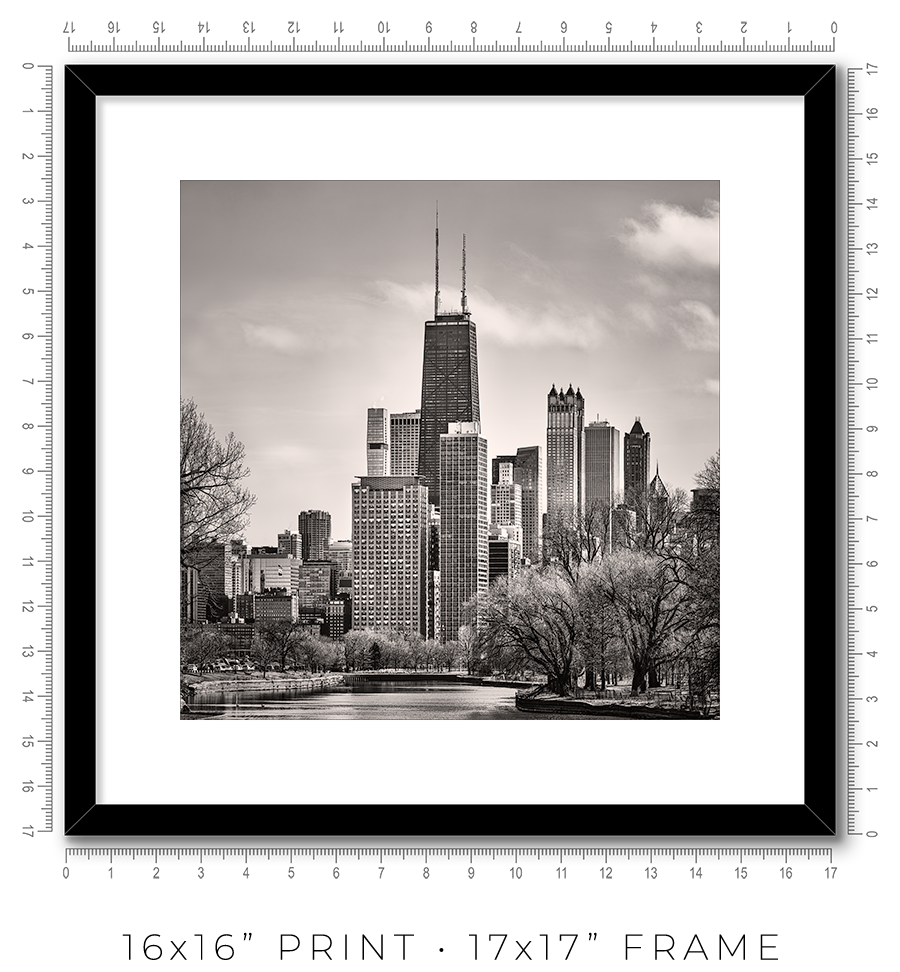
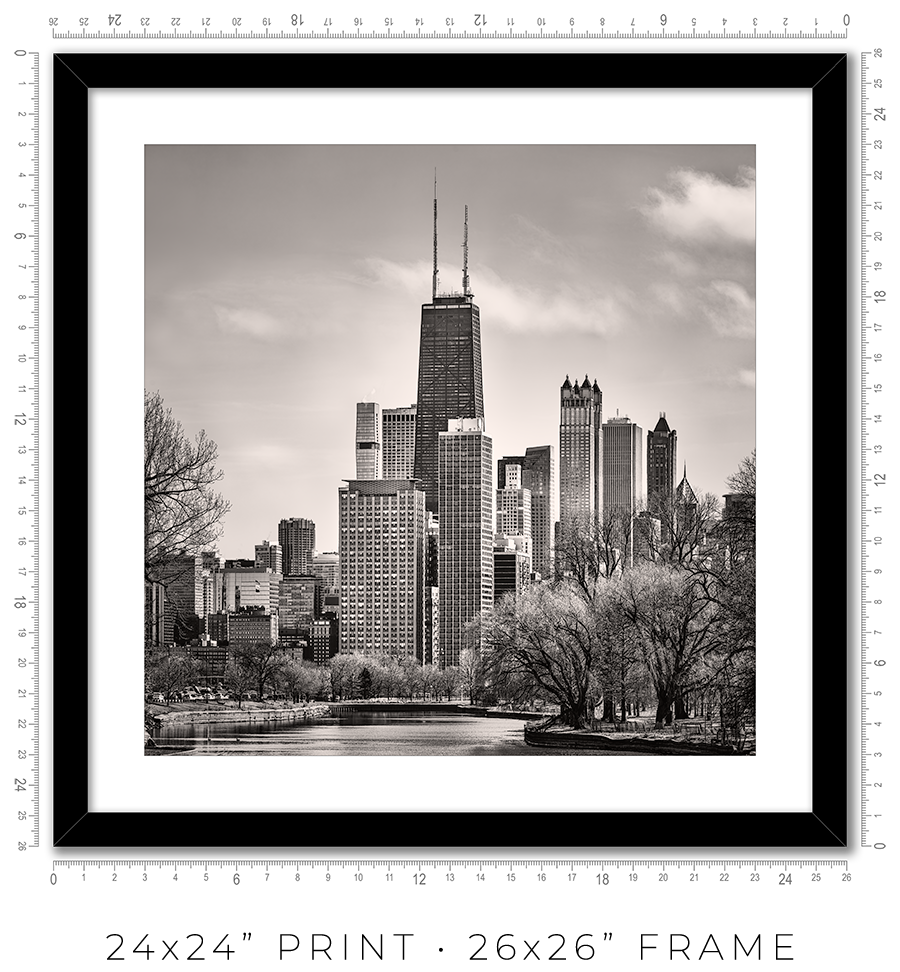
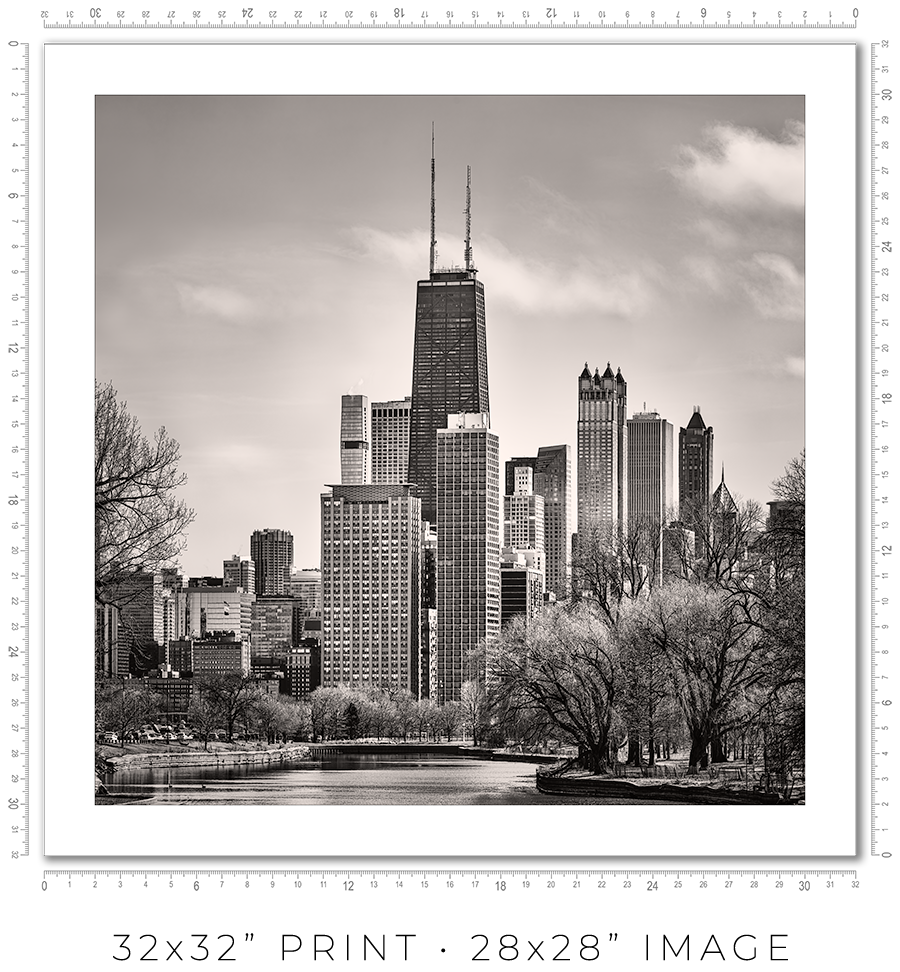
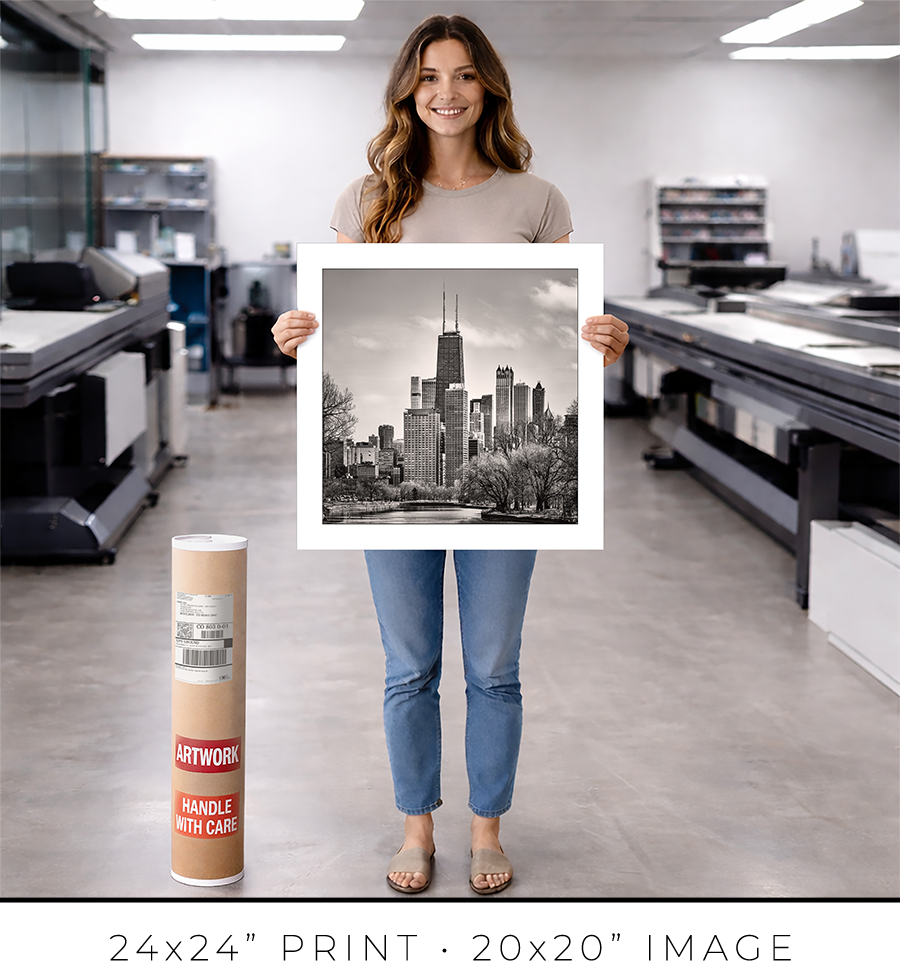
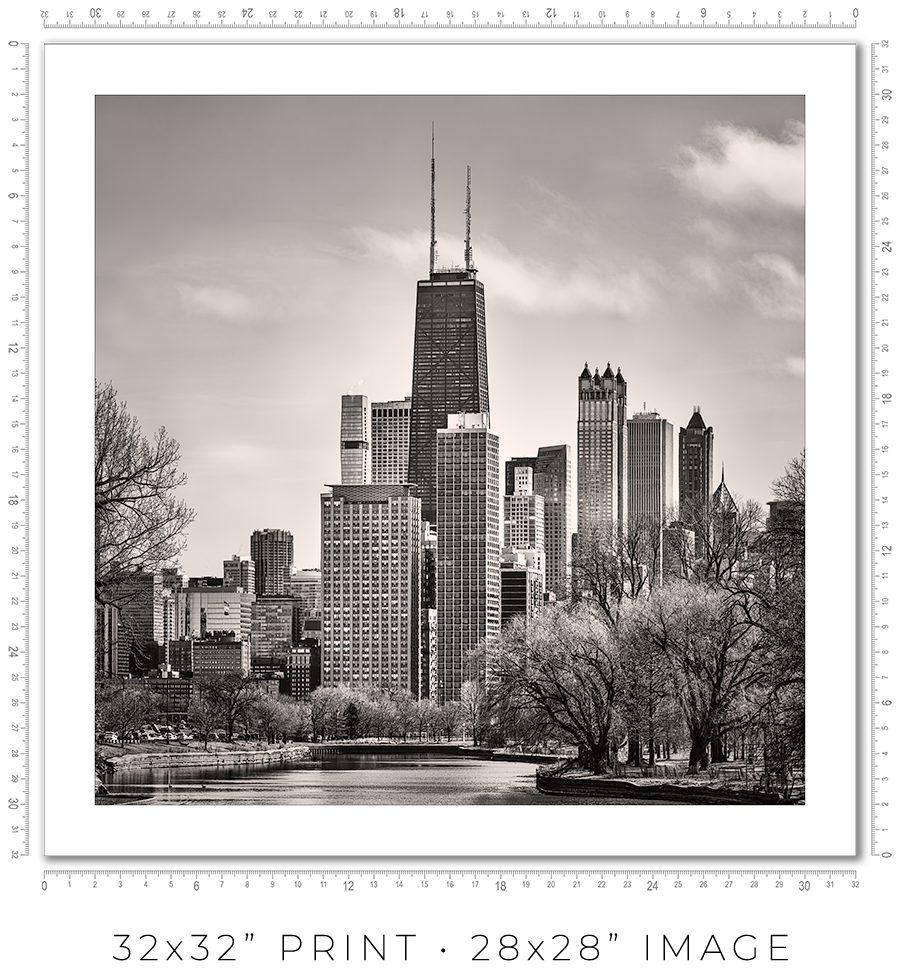
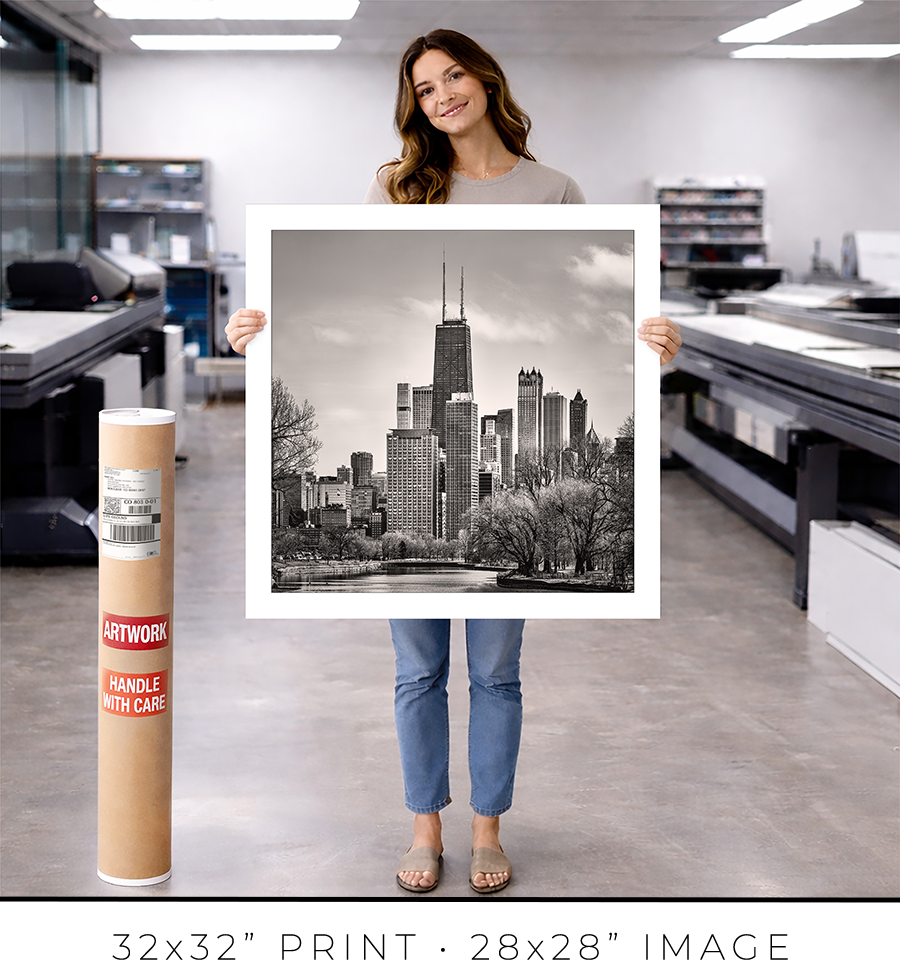
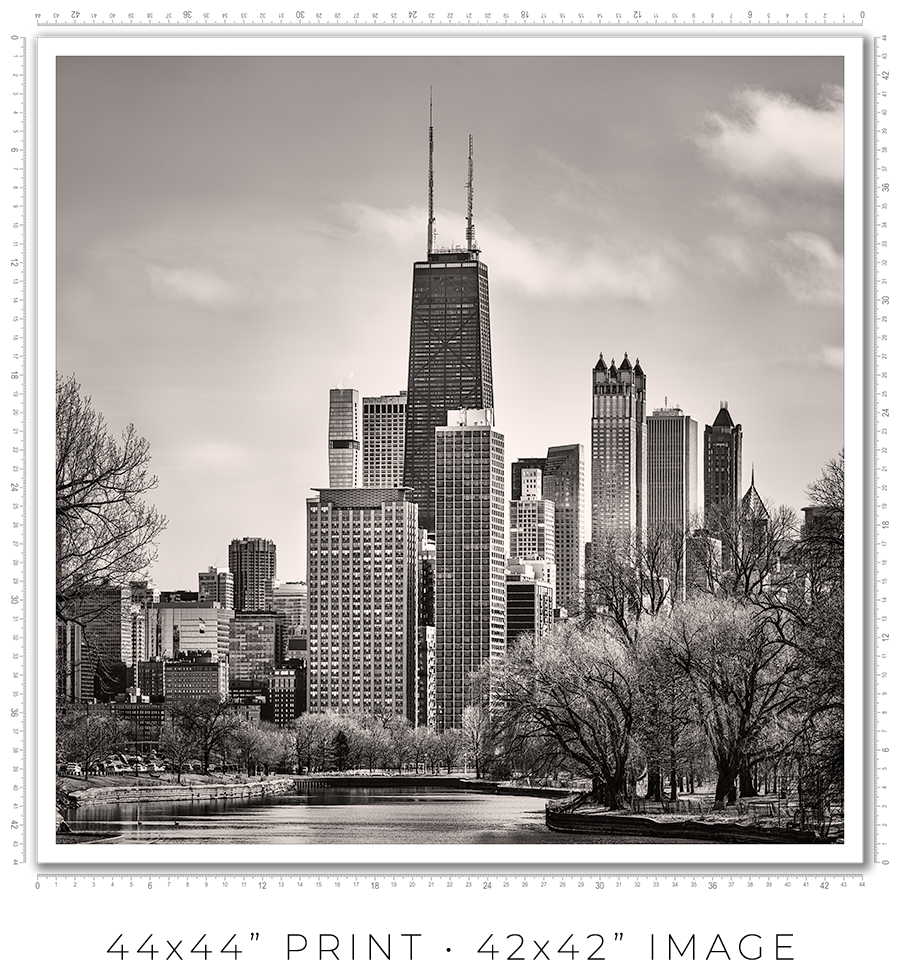
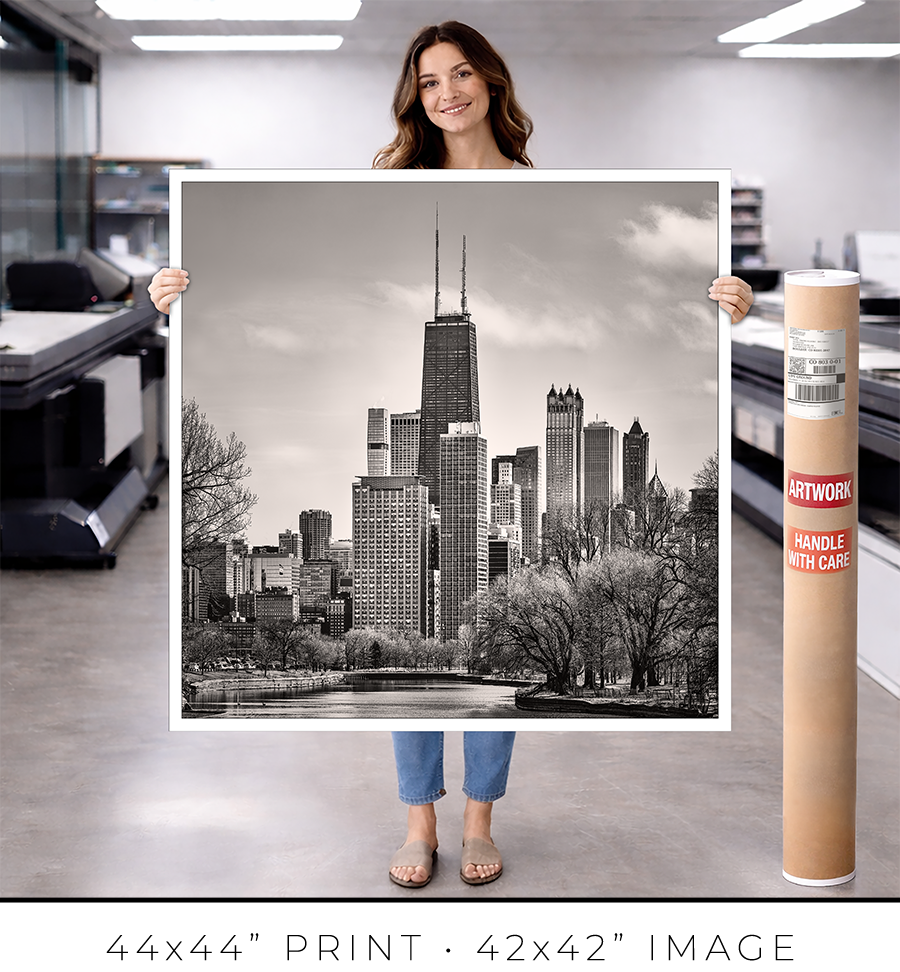
I owe you a clarification about print sizes. The framed print sizes listed on my website (16x16”, 24x24”, 32x32”, and 44x44”) refer to the sizes of prints mounted on the board before framing. But with the frame included, the outside dimensions will be obviously larger. Also, because of the white space (1” or 2”) around the image to separate it from the frame, the actual print size is smaller. Here is the table with all dimensions:
| Framed Print | Outside Dimensions | White Space | Actual Print |
| 16x16” | 17x17” | 2" | 12x12" |
| 24x24” | 26x26" | 2" | 20x20" |
| 32x32" | 34x34" | 2" | 28x28" |
| 44x44" | 50x50" | 1" | 42x42" |
And here is the sample picture to explain the dimensions table:

These are the standard frame options I offer on my website. If you need a custom frame or print sizes, please reach out to me, and I would be happy to help.
A photo print is an option if you want to frame it yourself or have a frame shop you know and trust that will frame it for you.
A photo print is just a loose print that I will send to you in a shipping tube.
I make prints myself in my studio. I use glossy metallic photo paper almost exclusively. It is the perfect paper for black-and-white architectural photography. It adds a distinctive pearlescent, three-dimensional sheen to the print.
The prints are part of a limited edition. They are signed and numbered just below the print. The Certificate of Authenticity is enclosed with the print.
I offer on my website three different sizes for photo prints: 24x24”, 32x32”, and 44x44”. If you need a custom size print, please let me know.
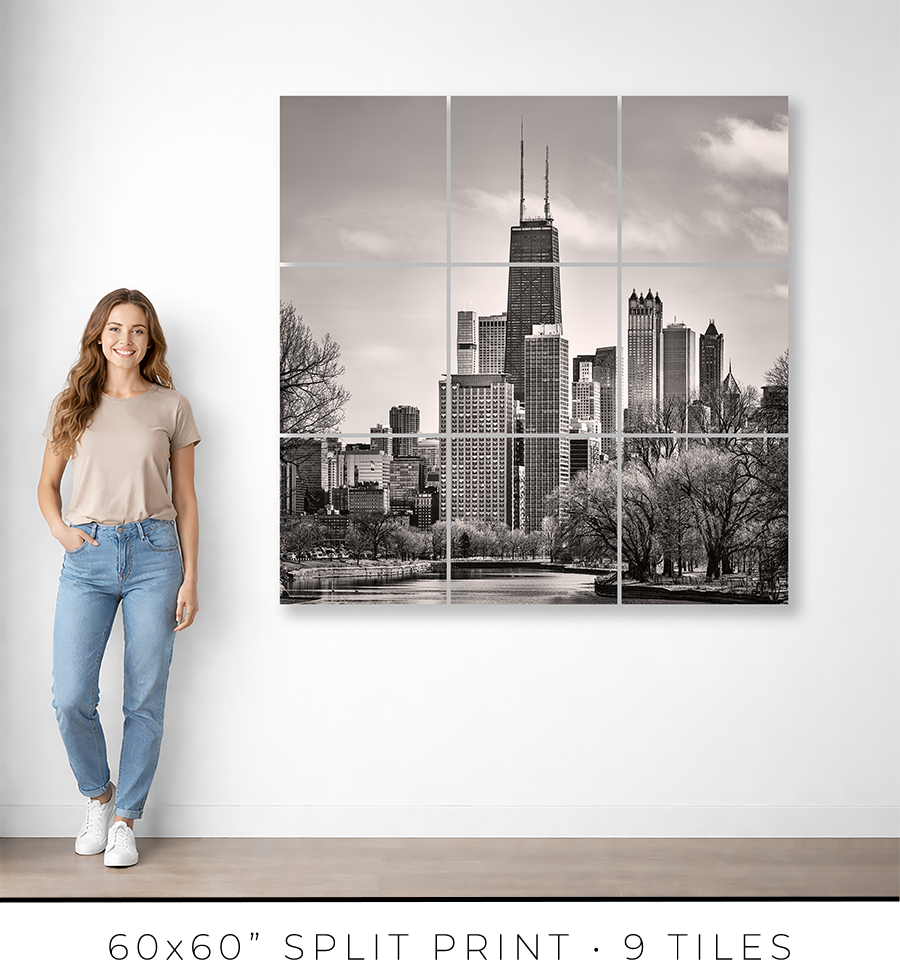
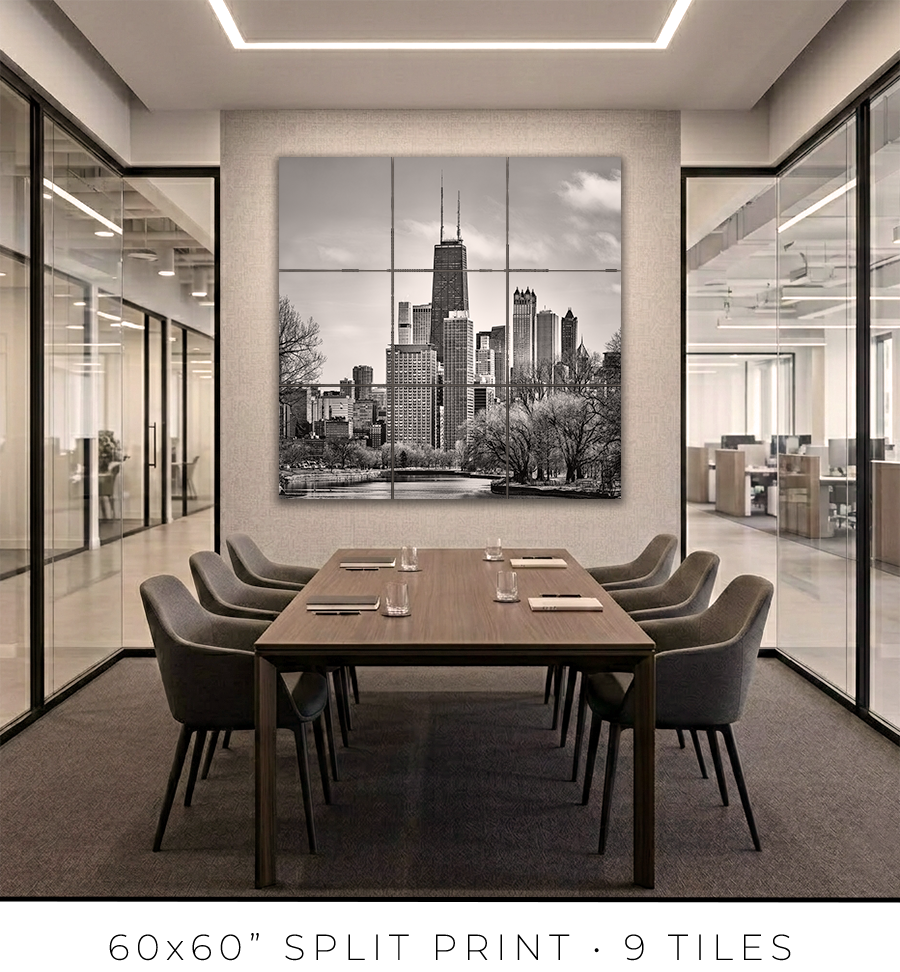
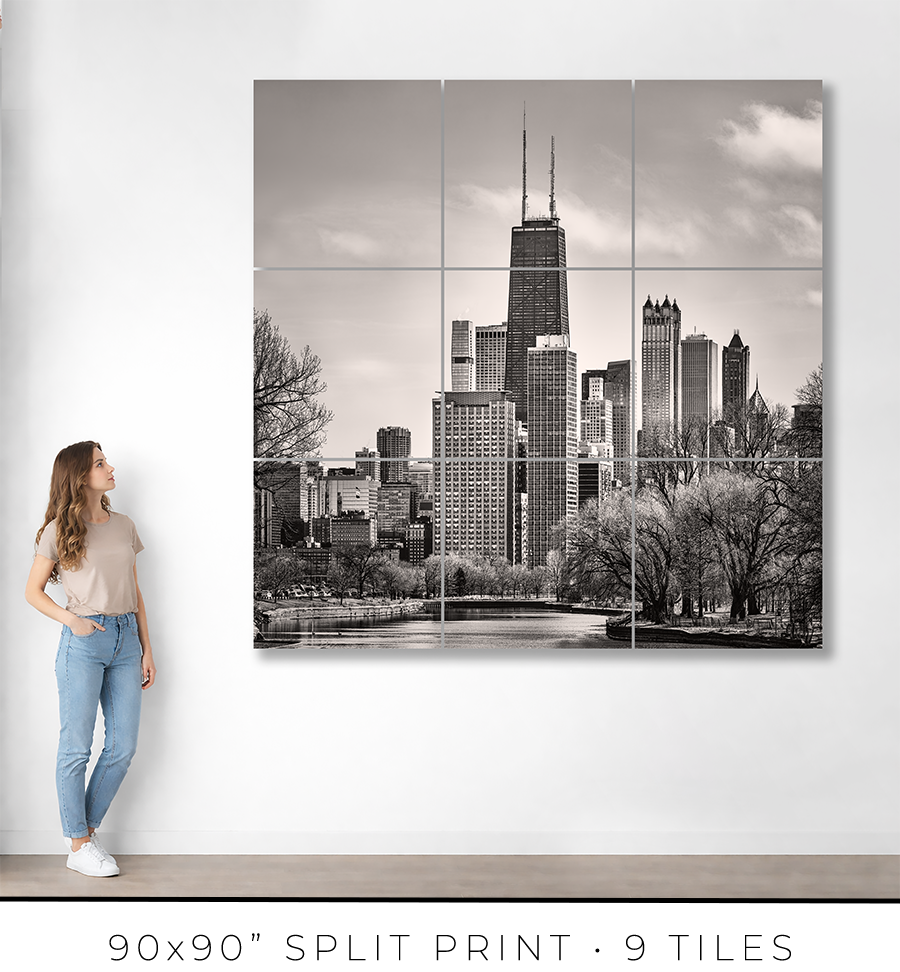
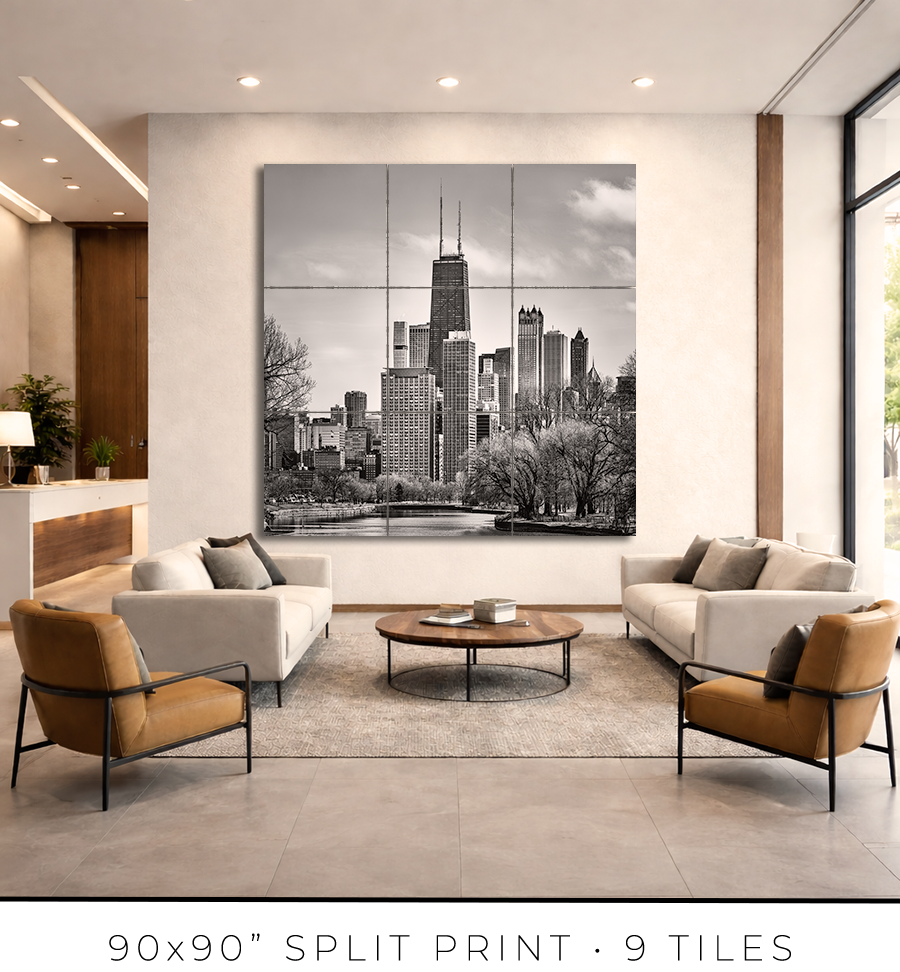
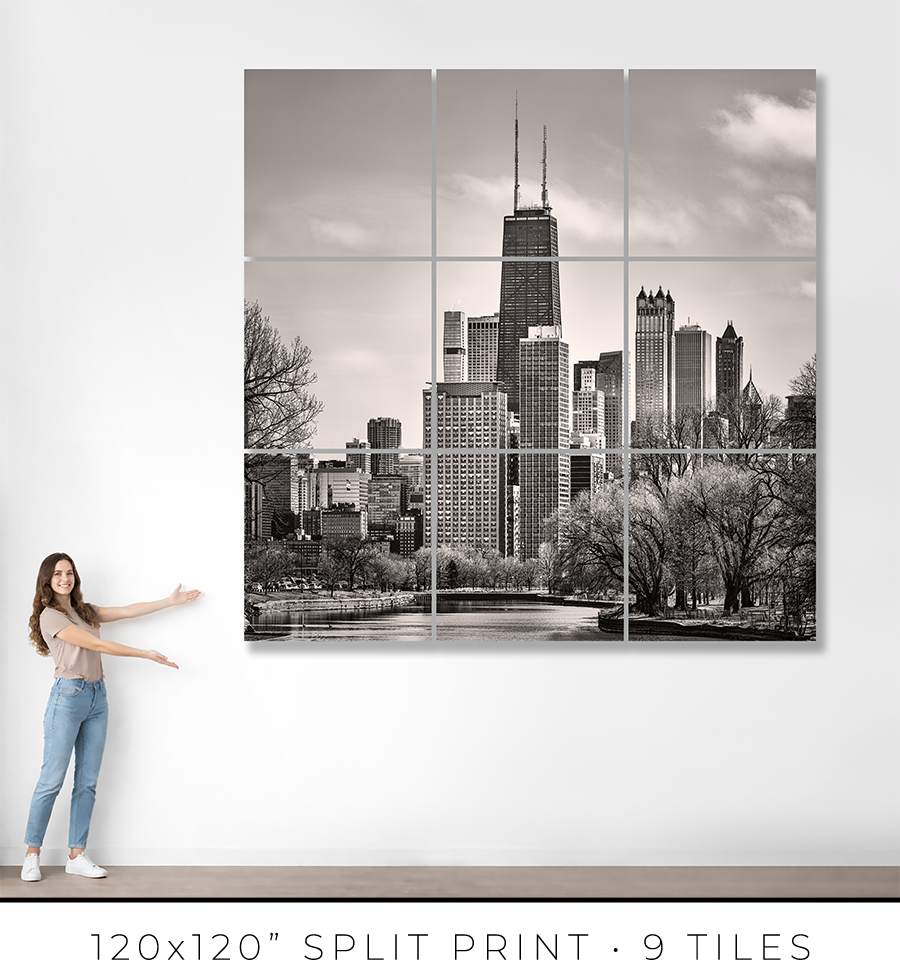
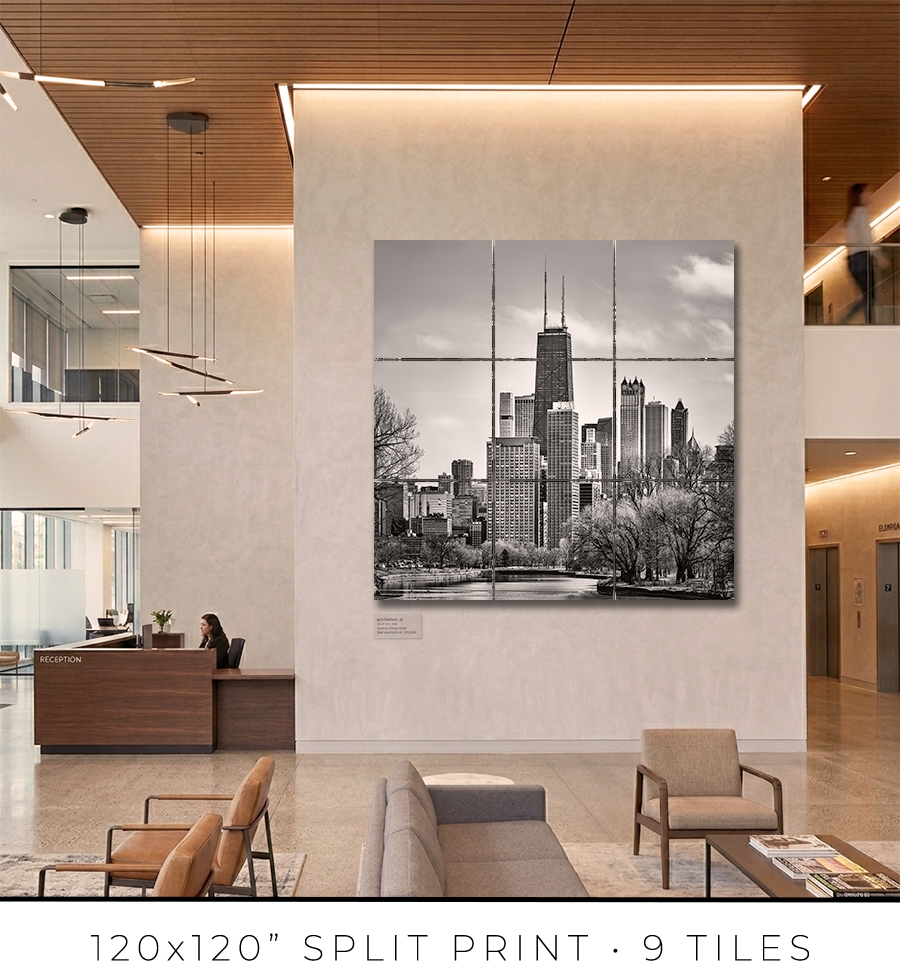
Split print is a great option if you want to go big, really big, up to 10 feet or maybe even bigger. It is a great option for office lobbies and for any place with large, tall walls.
There is a little “behind-the-scenes” story about split prints. I used to offer 60x60” on my website, but it was a mixed bag. First of all, that was the maximum print size I could make because all the materials (backing board, glass, etc.) do not come in sizes bigger than 60x60”. That was the ceiling I could not break. Second, the shipping of these prints was a nightmare. They are big and had to be shipped freight in a crate (not cheap), and every second print I shipped came back damaged, with big holes poked by careless forklift drivers at the sorting facilities.
There had to be a solution to these problems. And I found it in split prints.
Split print is a square print divided into nine (3 by 3) or more smaller squares. 60x60” print becomes a set of nine 20x20” prints, and 120x120” print is a set of nine 40x40” prints. No frame is required for this print presentation, as these are acrylic prints.

Acrylic print is a print on metallic photo paper face-mounted on a 1/4” thick sheet of acrylic (with polished edges) and sandwiched for strength with a sheet of aluminum Dibond. It is a modern, contemporary way to present a photographic print.
Because these are relatively small prints, compared to the final result, they can be shipped on a palette, which eliminates the shipping damage I had before. Plus, they are not heavy, and one person can easily put them on a wall using cleat hangers.
The best practice is to leave about a 1/4" or 1/2" gap between the acrylic print tiles. Since the edges of the acrylic prints are polished and the acrylic is quite thick at 1/4", it creates an interesting optical effect like looking through water.
If you are in the Chicagoland area, I will get you in touch with an installation guy I trust and have used for years, and he will help you install the split print in your home or office.
Each fine art print is produced specifically for you.
From the moment your order is confirmed, your print enters a deliberate production process: printing, inspection, drying, mounting, framing, final quality control, and secure packaging for shipping. Nothing is rushed. Every step is completed in-house to ensure consistency, precision, and permanence.
For matted prints and 16x16” framed prints, the production takes 1-2 days. For large framed prints, it takes 3-4 days.
If you are in the Chicagoland area, the shipping takes only one day. Large prints, I will deliver personally. I will contact you to schedule a delivery date and time that is convenient for you.
If you are outside of Chicago, the shipping takes 2-3 days, standard UPS Ground transit time. Large prints will be shipped in a crate built out of lumber and plywood. To open it, you might need a screwdriver, there will be many screws to remove.
You will receive an email with shipping tracking information once your order is ready for shipping.
Because most of the work is handmade in the studio, minor variations are part of the object's character. The result is not a mass-produced item, but a permanent piece crafted with attention.
Split prints are the only option I outsource to the photo lab. But I guarantee the quality of the prints because they are made under my supervision. Delivery time for split prints is about two weeks, but it can vary depending on the scope of the project.
If you have a specific deadline, please contact me before placing your order, and I will do my best to accommodate your timeline without compromising quality.
Each work is produced to order and crafted individually in my studio. Because of this, my payment and refund policies reflect the seriousness and permanence of the object.
Payments
Full payment is required at the time of purchase to secure your edition and initiate production.
I accept major credit cards and other secure payment methods at checkout. Production begins once payment is received.
There is an option at the checkout for “Payment in Person”. Please use it if you want to reserve your print but need to customize it and are unsure of the exact price. I will email you the invoice, which you can safely pay on my website later.
Refunds and Returns
All prints are made to order. As such, sales are considered final.
I do not offer refunds for change of mind, incorrect size selection, or personal preference. I encourage collectors to review dimensions, framing options, and placement carefully before purchasing.
If your work arrives damaged in transit, please contact me within 48 hours of delivery with photographs of the packaging and the piece. I will repair or replace the work as appropriate.
In the rare event of a production defect, I will make it right.
Cancellations
Orders may be cancelled within 24 hours of purchase, provided production has not yet begun. After production starts, cancellations are not possible.
I stand behind the quality, craftsmanship, and permanence of every piece. If you have questions before purchasing, I am always available to assist.
Stand on the West Fullerton Avenue bridge by Lake Shore Drive and look south. The South Lagoon opens beneath you, black and still. Beyond the water, beyond the ring of trees, the Gold Coast skyline rises. Steel and limestone. Glass catching light. The John Hancock's X-braces climbing into the sky.
You are standing on ground that once held the dead.
Before it was a park, this entire area was the old City Cemetery. Cholera victims. Confederate prisoners from Camp Douglas. Thousands of bodies in shallow sand graves so close to the surface that by the 1850s the corpses were leaching through the sandy soil into Lake Michigan, poisoning the city's drinking water. The city dug them up and moved them to Graceland and Rose Hill. Then it planted grass and trees and called it a park. Then it built a bridge so you could stand above the lagoon and look south at one of the great urban vistas in America.
Chicago does not sentimentalize its history. It buries the dead and builds something beautiful on top.
The bridge itself is easy to overlook. That is the point. Low concrete arches. Solid balustrades. Modest ornamentation. Early 20th-century restraint, built to blend into the landscape rather than to announce itself. It does not move, lift, or pivot. It is not one of Chicago's celebrated river bridges, the great downtown bascules that swing open for freighters. This bridge simply holds the road, the joggers, the cyclists, and the photographers. It sits at a precise elevation and angle over the lagoon, and that precision is its entire architectural argument. The frame does not move. Only the city behind it has evolved.
Below the bridge, the South Lagoon does its work. Landscape architect O.C. Simonds designed these conditions: quiet and sylvan, a managed wilderness that creates the right frame for seeing. The lagoon doubles everything. The towers and their reflections. The tree line and its shadow. The sky and its twin. The water does not simply reflect the skyline. It steadies it. It gives the eye a place to rest before it climbs.
The lagoons were not natural. They were engineered, deliberate, and picturesque features designed to soften the city's geometry and give the skyline a pastoral foreground. Daniel Burnham's 1909 Plan of Chicago said the lakefront should remain forever open, clear, and free. The lagoons are the instrument of that policy. They are what forever open and clear looks like from the ground.
Dominant in the composition is the John Hancock Center, 875 North Michigan, completed in 1969. One hundred stories. X-braces marching up the exterior like the ribs of some enormous animal. Fazlur Rahman Khan of Skidmore, Owings & Merrill designed the structural system, and it was a revolution. Not a reformation. A revolution. Khan moved the building's structural resistance to its skin. The exterior diagonals carry the load. Interior columns disappear. Floors open. The building holds itself up through its own geometry rather than its mass. The X-braces are not decoration on a building. They are the building.
The tower tapers as it rises: wider at the base for retail and parking, narrower at the top for the 700 condominiums that hover above the city. The shape is not arbitrary. It is the form that follows from the problem. More than 190 feet of foundation columns sink below the surface to bedrock, driven down after air pockets were discovered threatening to pull the structure sideways during construction. The building that stands above the lagoon earned its place in the sky.
Before it, closer to the park, 1550 North Lake Shore Drive sits in Miesian silence. Completed in 1960, it is a white brick and steel frame, grid and repetition, the building stripped to its essential nature and left there without apology. Where the Hancock dramatizes its own structure, 1550 refines structure into quiet. It does not announce itself. It simply is. From the bridge, these two buildings read as a conversation across decades: one in diagonals, one in right angles. One that shouts. One that does not need to.
The Gold Coast, which produced these towers, did not exist before 1882. Potter Palmer, the merchant prince of State Street, bought swampy lakefront land that no one wanted and built himself a 42-room castle on it. Chicago's most prominent families followed him north, the McCormicks and Ryersons and Swifts. Land values rose by 400 percent over the years. Palmer had converted marsh grass into gold by the act of moving there. This is what ambition does in a young city. It does not find the prestigious neighborhoods. It creates them.
The mansions gave way to towers. Mies van der Rohe brought his grid to Lake Shore Drive. The horizontal estates became vertical ones. The Gold Coast grew upward because land along the lake ran out, and because there was no reason to stop. Further back in the composition, 900 North Michigan stands with its four pyramidal lanterns, Art Deco crown completed in 1989. Adjacent to it, 11 East Walton in grey mansard and cobblestone motor court, Haussmannian Paris on the North Side, luxury reinterpreted for a new century. These buildings do not pretend to be modern. They quote history deliberately. They know what the neighborhood was, and they choose to speak its language.
What you see from the Fullerton Bridge is not a collection of buildings. It is a negotiation. Every tower negotiating with the water, with the trees, with the sky. The lagoon mediating between Lincoln Park's deliberate wildness and the Gold Coast's deliberate ambition. The bridge mediates between both. The city and the park have been arguing this way for more than a century, and from the bridge you can see they have reached a truce.
The bridge is not monumental. It makes monuments visible. That is a different kind of achievement, and a harder one. Anyone can build a tower. It takes a city that understands itself to build the place from which the tower is seen correctly.
You are standing where they buried the dead. On a bridge built to disappear into its surroundings. Looking at what a city raised when it decided that death and swampland were not reasons to stop.
Have a look at this view. Look at what gets built on the ground that was given up for lost. Then ask yourself what you have given up on. Ask yourself what you are waiting to build in your life.
Choose options